
Imagine you are a child. In the middle of the night, your mom drops you off at your grandma’s house to live. Your mom and dad can’t care for you anymore. Their alcohol use has made it impossible to parent. You’re glad to be with your grandma because it feels safe and comfortable at her house, but you’re worried about some things. Where will you go to school? How will you get your asthma medicine? Can your grandma get it for you? Will your mom and dad be okay?
Parental alcohol and other substance use is just one of the many reasons kinship/ grandfamilies come together. We use the terms “grandfamilies” and “kinship families” interchangeably – and combined as “kinship/grandfamilies” – to refer to families in which grandparents, other adult family members, or close family friends are raising children whose parents are unable to do so. Other reasons kinship/grandfamilies form include parental incarceration, military deployment, severe disability, deportation, teenage pregnancy, or death. Whatever the cause, when parents are unable to care for their children, kin caregivers often step in at a moment’s notice to keep families together.
Kinship/grandfamilies have unique strengths and face unique challenges. Unlike parents, kin caregivers do not have automatic legal rights and responsibilities with respect to the children they raise. They often take responsibility for children suddenly and have no time to plan for the children’s housing, educational, or other needs.
What does the research show about the strengths of kinship/grandfamilies?
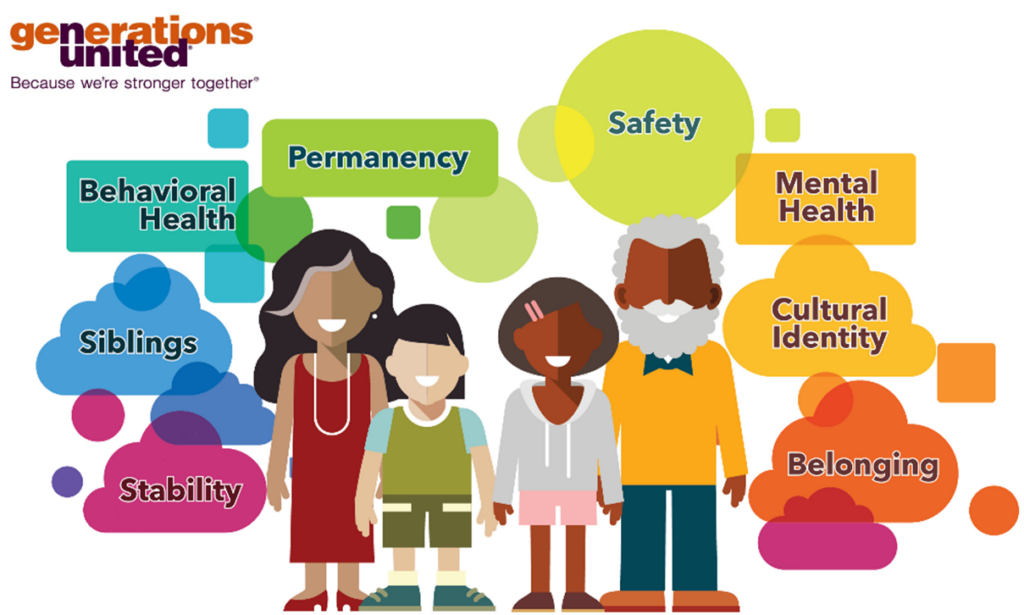
Decades of research proves that children who cannot remain with their parents thrive when raised by relatives or close family friends. Children in foster care with relatives have safer and more stable childhoods than children in foster care with non-relatives, with a greater likelihood of having a permanent home. They experience fewer school changes, have better behavioral and mental health outcomes, and report that they “always felt loved.” They keep their connections to their siblings, their family and community, and their cultural identity. Moreover, children in foster care with relatives are less likely to re-enter the foster care system after returning to their birth parents. If returning to their parents is not possible, relatives tend to be willing to adopt them or become their permanent guardians. In 2025, 43% of all children who exited foster care to adoption were adopted by a relative or kin and at least 44% of all children who exited foster care to guardianship left with a relative or kin caregiver as their guardian. Data is missing for another 44% of guardianships, so the available statistic is likely a significant undercount.
On top of the many benefits to children, caregivers report that they gain heightened feelings of purpose, joy, and satisfaction. Birth parents may also value that their children remain connected to family and friends.
We have friends who are retired who are always telling me about their next cruise to Hawaii. I tell them I go on cruises every day. I cruise to school, I cruise to the doctor’s office, I cruise to the skateboarding park. Joey is my ‘cruise to Hawaii’ and you know what, I wouldn’t trade my cruise for theirs.
Adrian Charniak, GRAND Voice caregiver advocate, Illinois
How many children live in kinship/grandfamilies?
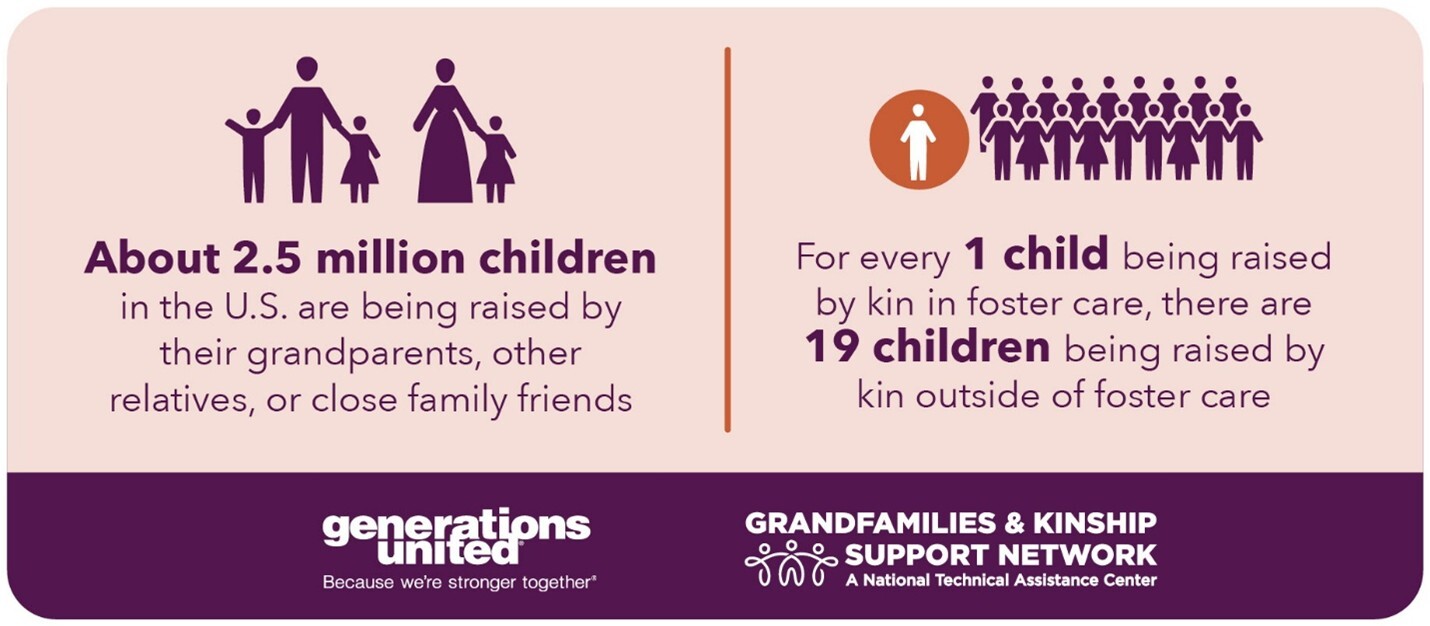
- About 2.5 million children are being raised by a grandparent, other relative, or close family friend and do not have a parent living in the household.
- There were 128,120 children in the legal custody of the child welfare system with relatives or kin providing their care in 2025, representing 39% of all children in foster care.
- About 44% of these children were in unlicensed homes, which generally means that all the rules and restrictions of the foster care system applied to them, but they did not receive foster care maintenance payments to help meet their needs. Increasingly, states and Tribes are implementing kin-specific foster care licensing standards to support children in kinship foster homes the same way they support other children in foster care.
- The percentage of children in foster care with relatives increased from 30% in 2015 to 39% in 2025.
- For every one child in the foster care system with a relative providing the care, there are nineteen children being raised by relatives outside that system.
What does available data show about kinship/grandfamilies?
Most of the publicly available data about kinship/grandfamilies is limited to grandparents and the grandchildren they raise. The U.S. Census Bureau’s American Community Survey is the primary source for this information. It includes data on families in which grandparents are the head of the household (meaning that they own or rent the home) and self-report that they are responsible for their grandchildren. Similar caregiver and child data is not regularly available for families headed by other relatives, like aunts, uncles, or siblings, or kin unrelated to the children they are raising. However, the U.S. Government Accountability Office (GAO) released a report in December 2025 that contains some data that covers all kinship families, and we share that relevant data below.
Technical Assistance Tip:
To find the latest national information, as well as guidance and links to help you access information specific to your area, visit the Kinship/Grandfamilies Data webpage.
Most kin caregivers are grandparents.
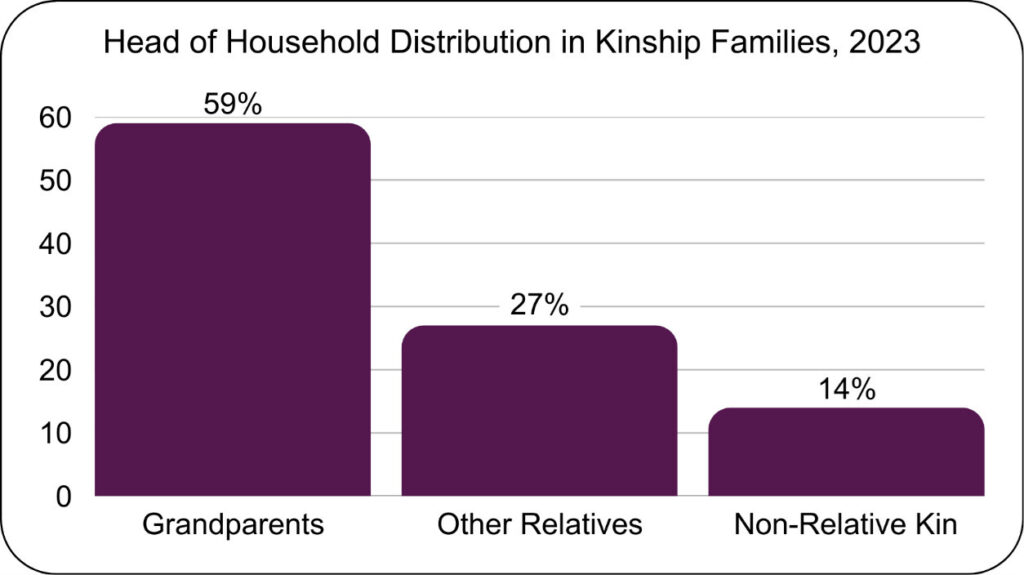
- According to the GAO, in 2023, 59% of children in kinship/grandfamilies lived in homes in which their grandparents were the head of household, 27% lived in homes with another relative as the head of household, and 14% lived in homes with non-relatives (like close family friends) serving as the head of household.
Kinship/grandfamilies are racially and ethnically diverse.
- The GAO reports that, among all children living in kinship/grandfamilies, 38% are white, 23% are Black or African American, 29% are Hispanic or Latino, 3% are American Indian and Alaska Native, 2% are Asian, 1% are Native Hawaiian or other Pacific Islander, and 5% are more than one race.
- Among grandparents who are responsible for their grandchildren, about 56% are white, 20% are Black or African American, 20% are Latino or Hispanic, 4% are Asian, 2% are American Indian and Alaska Native, 0.4% are Native Hawaiian and other Pacific Islander, 10% are two or more races, and 8% are some other race.
- Some racial and ethnic groups are overrepresented in kinship/grandfamilies. While this overrepresentation is likely a product of the centuries-long shameful treatment of these communities by the United States and the many inequities these communities continue to face, it is also a reflection of their cultural strengths and resilience.
Technical Assistance Tip:
To provide culturally appropriate services for kinship/grandfamilies who are Black or African American, American Indian and Alaska Native, and Latino, consult the racial equity toolkits and tip sheets created for service providers by Generations United.
Members of kinship families are all ages.
- Among all children living in kinship/grandfamilies, approximately 24% are under 6 years old, 33% are between the ages of 6 and 11, and 44% are between ages 12 and 17, according to the GAO.
- The percentage of grandparents who are raising their grandchildren and are age 60 and over has increased in the last 10 years. In 2023, approximately 50% of grandparents who were responsible for their grandchildren were age 60 or over, compared to about 36% in 2014.
Technical Assistance Tip:
With our partners at ZERO TO THREE and USAging, the Network can help you design policies and programs to support kinship/grandfamily members of all ages.
Most kinship families have one child in the household.
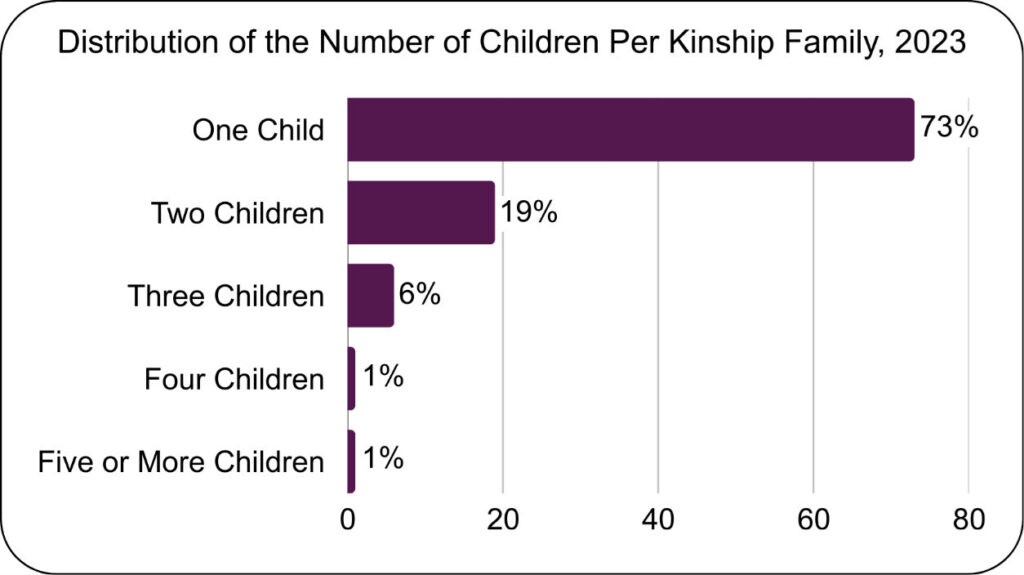
- In 2023, 73% of kinship/grandfamilies were one-child households, another 19% had two children, 6% had three children, 1% had four children, and 1% had five or more children, according to the GAO.
Most grandparent caregivers are women.
- About 63% of grandparents living with and responsible for their grandchildren are women.
Most grandparent caregivers are in the labor force.
- Approximately 55% of grandparents responsible for their grandchildren are in the labor force.
Technical Assistance Tip:
Child care programs, including before- and after-school activities, are key for many families, especially those with caregivers who are in the labor force. See this brief resource on helping connect families to child care.
Kinship families are more likely to be living in poverty than other families.
- The poverty rate for kinship families is 19%, while the poverty rate for all families is 13%, according to the GAO.
Technical Assistance Tip:
Kin caregivers often need financial resources and support to meet the needs of children they did not plan or expect to raise. Initiatives like Washington, DC’s Grandparent & Close Relative Caregiver Subsidy Programs, designated by the Network as Exemplary, can be replicated by other jurisdictions.
Children in grandparent-headed households are more likely than the general population of children to have health issues, and grandparent caregivers are more likely than parents to have a disability.
- The GAO found that 31% of children who are living with their grandparents have two or more “current or lifelong health conditions from a list of 24 health conditions,” compared to 20% of the general population of children. They also found that 38% of children ages 3 to 17 who are living with their grandparents “have a mental, emotional, developmental or behavioral problem,” compared to 26% of the general population of children.
- Approximately 26% of grandparents who are responsible for their grandchildren have a disability, compared to about 7% of parents of children under age 18.
Technical Assistance Tip:
Kinship navigator programs play a critical role in providing information on the range of services – including health and disability services – that may be available to grandfamilies. The Network has a list of all known kinship navigator programs around the United States. Six programs – in Arizona, Colorado, Florida, Nevada, Ohio, and Washington – are included in the Title IV-E Prevention Services Clearinghouse and are eligible for ongoing federal reimbursement of up to 50% of all costs. Other jurisdictions can follow these models with fidelity to access the same federal funds.
Grandparents are raising their grandchildren for long periods of time.
- In 2021, about 49% of grandparents who were living with and responsible for their grandchildren reported that they had been responsible for their grandchildren for five or more years.
- U.S. Census Bureau researchers have found that “[g]randparents were more likely to be responsible for their grandchildren for 5 years or longer in 2021 compared to 2012.”
Grandparents are raising their grandchildren all across the country.
- Kinship families exist all across the country. However, there are regional differences. Researchers have found that grandparents who live with their grandchildren in states in the South and Midwest report that they are responsible for their grandchildren at a higher rate than their peers in other regions.
Technical Assistance Tip:
It is important for all communities to develop and deliver supportive services for all kinship/grandfamilies. It may be helpful to learn about Exemplary programs and practices and get tips to replicate them.
What challenges do kinship/grandfamilies face?
Even with the strengths highlighted above, grandfamilies encounter many difficulties. Below are key areas in which families face challenges, along with resources to help professionals learn more and discover effective ways to better support the families they partner with and serve.
Legal
Legal issues are frequently among the top concerns for grandfamilies.
- Unlike parents, kin caregivers do not have automatic legal rights and responsibilities with respect to the children they raise.
- The process of obtaining a legal relationship with the children – such as adoption, legal custody, or guardianship – is usually expensive and time-consuming and can be disruptive to family dynamics.
- Opting to raise the children without any legal relationship may severely limit caregivers’ ability to access services on the children’s behalf.
Technical Assistance Tip:
The Network hosted a webinar on the array of legal relationships available to grandfamilies. Access the webinar recording and a fillable PowerPoint template to learn about the options and conduct your own trainings.
Financial
Having additional children in the household typically requires additional income or resources, but available ongoing assistance to help meet these children’s needs is frequently inadequate and inequitable.
- Temporary Assistance for Needy Families (TANF) child-only grants are often the only source of ongoing financial support for the vast majority of children who are being raised by kin outside of foster care. However, there are many access issues in getting these grants, and they are typically much smaller than foster care maintenance payments. Also, TANF child-only grants generally only increase incrementally for each child, so a caregiver raising more than one child only gets a slight increase in support for each additional child in their family, rather than receiving an equal amount of support to meet the needs of each child.
- Children in foster care with licensed foster parents receive monthly foster care maintenance payments (FCMPs). Most kin caregivers were not foster parents before taking responsibility for the children, and many remain unlicensed. Nearly 44% of children living with kin in foster care were living with unlicensed kin caregivers in 2024. Because licensure is tied to the receipt of FCMPs, these children are typically not supported like other children in foster care. A 2023 federal rule and new kin-specific foster care approval standards are beginning to address this issue.
Technical Assistance Tip:
For data on TANF child-only benefits in your state and around the country, see Uneven Support for Kinship/Grandfamilies: State TANF Child-Only Grants. For replicable practices and policies to increase access to TANF child-only benefits, see Improving Support for Kinship/Grandfamilies: State Strategies for TANF Child-Only Grants and Related Assistance.
Physical and Mental Health
Both the caregivers and the children in grandfamilies tend to face more physical and mental health issues than the general population.
- Children being raised by kin caregivers exhibit a variety of physical, behavioral, and emotional challenges to a greater degree than the general population of children, often due to the difficult situations that caused them to move into their caregiver’s home.
Growing up with a childhood full of trauma and abuse, there were very few moments where I felt safe and very few people with whom I felt protected. Being put into my uncle’s care was the best decision that could have ever been made for me. It wasn’t an easy road by any means, but I have no doubt in that it completely saved my life.
Kindra, raised by her uncle, California
- Kin caregivers are often socially isolated from their peers and may feel guilt and shame about their adult relative or friend who is unable to parent, especially if it is their own adult child. They may neglect their own physical and mental health as they focus on caring for the children.
- Families frequently face obstacles enrolling the children in either public or private health insurance. Some states impose restrictive policies that make it difficult to enroll the children in Medicaid. Private insurance often requires adoption for children to be included on caregivers’ policies.
- Kin caregivers may not be permitted to consent to health care for the children in their care, depending on whether they have a legal relationship with the children and whether their state has a health care consent law.
Technical Assistance Tip:
For professional trainings regarding mental health issues, see Guide for Providers: No-Cost Training Resources on Kinship/Grandfamily Mental Health Needs. If you work in patient care, consider taking the free, 30-minute Engaging Kin and Grandfamily Caregivers course from the University of California San Francisco’s Caregivers As Partners in Care Teams initiative. Additionally, you can share these tip sheets on caregiver self-care and youth mental health with the caregivers you serve.
Housing
Kin/grandfamily caregivers often begin caring for children without warning or preparation, and they face unique problems with respect to housing.
- Many kin caregivers live in small apartments and houses that are not suitable for children.
- The presence of children may violate private lease agreements.
- If caregivers do not have legal custody of the children, public housing authorities may not recognize them as a “family” that qualifies for additional bedrooms.
Technical Assistance Tip:
Over 20 grandfamily-specific housing developments exist around the country. For a list, visit Housing Developments for Grandfamilies.
Education
Many school policies are geared towards “nuclear” families and can pose obstacles for kinship/grandfamilies, especially those families in which there are no legal ties.
- Children may be denied school enrollment if their kin caregivers do not have guardianship or legal custody.
- Grandparents, other relatives, and close family friends acting as parents may have difficulty being included as participants in the Individualized Education Program (IEP) process for children with disabilities.
Technical Assistance Tip:
Review Five Actions for Supporting Students and Caregivers in Kinship/ Grandfamilies: A Toolkit for K-12 School Professionals and Kinship Service Providers to learn about how to better support students and caregivers in kinship/grandfamilies. The five actions each include specific steps and embedded tools.
Additional Resources
- www.GKSNetwork.org – A resource library with materials to help the many government systems and community nonprofits working to support kinship/ grandfamilies
- www.gu.org – Resources and publications on kinship/grandfamilies, including Generations United’s State of Grandfamilies & Kinship Care Reports
- www.grandfamilies.org – A comprehensive website for publications, materials, and laws impacting kinship/grandfamilies both inside and outside the foster care system
Acknowledgements
As an aid towards improving public knowledge about kinship families, the Grandfamilies & Kinship Support Network – the first and only national technical assistance center on kinship/grandfamilies, built and run through a cooperative agreement with the Administration for Community Living – has updated this long-standing resource of Generations United. A previous version was funded by The Brookdale Foundation Group, and we thank them for their support. You are welcome to link to this resource, download it, freely distribute it, and use it.
The Network helps government agencies and nonprofits in states, Tribes, and territories work across jurisdictional and systemic boundaries to improve supports and services for families in which grandparents, other relatives, or close family friends are raising children whose parents are unable to do so. For more information, please visit www.GKSNetwork.org.


